
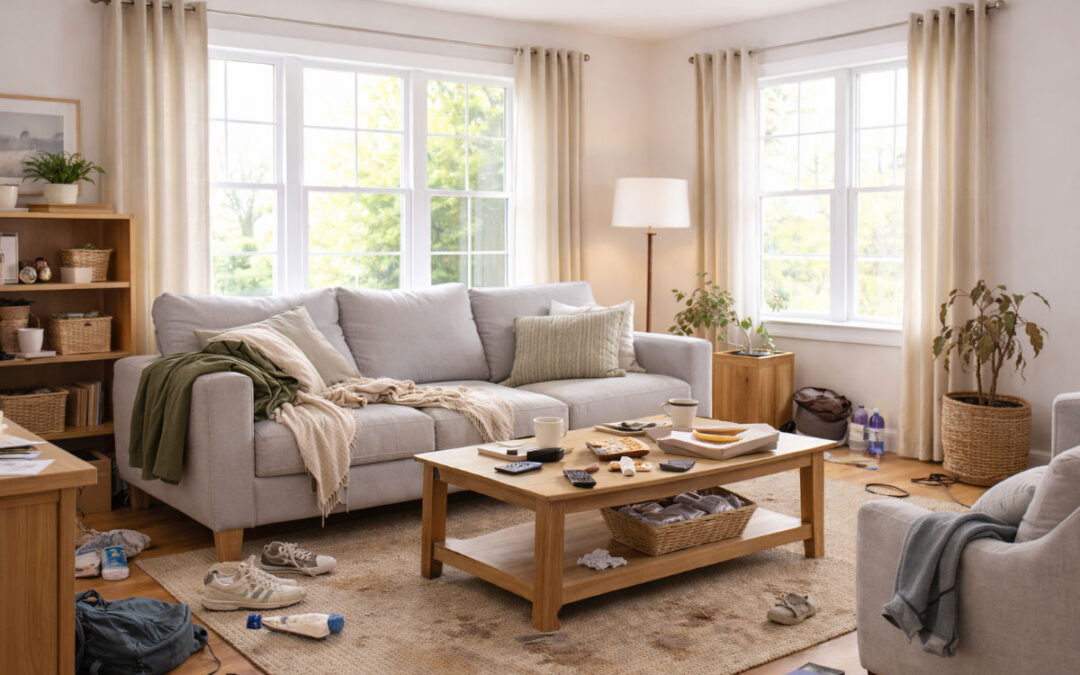
We can all tell when a room isn’t working.
Maybe the kitchen feels harder to cook in. The living room becomes a pass-through instead of a gathering space. The home office has a lowkey sense of obligation before we even open our laptop.
Research in environmental psychology suggests something interesting at play: clutter and visual disorder quietly change how our brains respond to a space. Clutter drains mental energy and subtly alters how we perceive the room, and can even change how we use the space.
A Hidden Stress Response
APA.org details a study on how our surroundings shape our thoughts and behavior. What is the actual cost of the distraction?
The researchers observed a real cognitive and physiological load, reducing task efficiency and was also associated with elevated levels of cortisol (the body’s primary stress hormone).
Chronically elevated cortisol levels are linked with:
- Tension and anxiety
- Fatigue
- Difficulty concentrating
- Lower sleep quality
When you walk into a cluttered room, your brain stays in a low-grade alert state: scanning, processing, prioritizing, and trying to filter out distractions. That’s cognitive load. (Source: APA.org)
The practical impact isn’t abstract:
- A cluttered home office makes it harder to start working and stay focused.
- A disorderly kitchen becomes an obstacle to meal planning and cooking.
- A chaotic living room is where people pass through, not linger.
Order Shapes Decision-Making and Behavior
A well-known set of experiments from the Association for Psychological Science found that people in tidy environments were more likely to make conventional, health-oriented decisions than those in cluttered settings. In controlled studies, participants in clean rooms donated more to charity and chose an apple over a candy bar more often than those in messy rooms, suggesting that order nudges behavior toward healthier, more socially aligned choices.
Researchers explain this as a form of behavioral conformity: when our surroundings are orderly, we subconsciously “match” our actions to that order.

Clean, open kitchen counters don’t just look nicer — they reduce activation energy for cooking.
Clutter creates visual distractions that demand mental effort, making it harder to focus on what you intended to do next. That’s why a cluttered kitchen often feels like it requires more motivation than it really does: your brain is processing visual noise before it even gets to the task at hand.
In contrast, cluttered living spaces subtly send a signal that the room isn’t ready, which makes people more likely to “just pass through.” While the research on social behavior specifically in residential spaces is still growing, the principles uncovered in environmental psychology consistently show that physical order influences social engagement and perceived environmental support.
In a home office, that can mean:
- Projects taking longer than they should
- More frequent distractions
- Lower follow-through on daily goals
What This Means for Busy Families in the Triad
Most families in Kernersville, Greensboro, Winston-Salem, High Point, Mocksville, and Burlington are stretched while managing work schedules, school activities, commutes, sports practices, church commitments, errands.
It compounds throughout the day.
A kitchen that feels chaotic makes dinner feel harder to start. Cluttered entryways turn leaving the house into a daily scramble. Messy living rooms discourage relaxation together.
At its core, the research we’ve discussed about baseline order and cleanliness.
A home doesn’t need to look staged. It needs to feel usable.
For busy families across the Triad, consistent professional cleaning provides that stability. It keeps core living spaces reset so they function as intended — without requiring another Saturday lost to scrubbing and catching up.
A consistent, professional cleaning schedule keeps your core living spaces reset so they function the way they were designed to — without adding more to your plate.
If you’re in Kernersville, Greensboro, Winston-Salem, High Point, Mocksville, or Burlington, we’re here to help you build that consistency.